Short answer
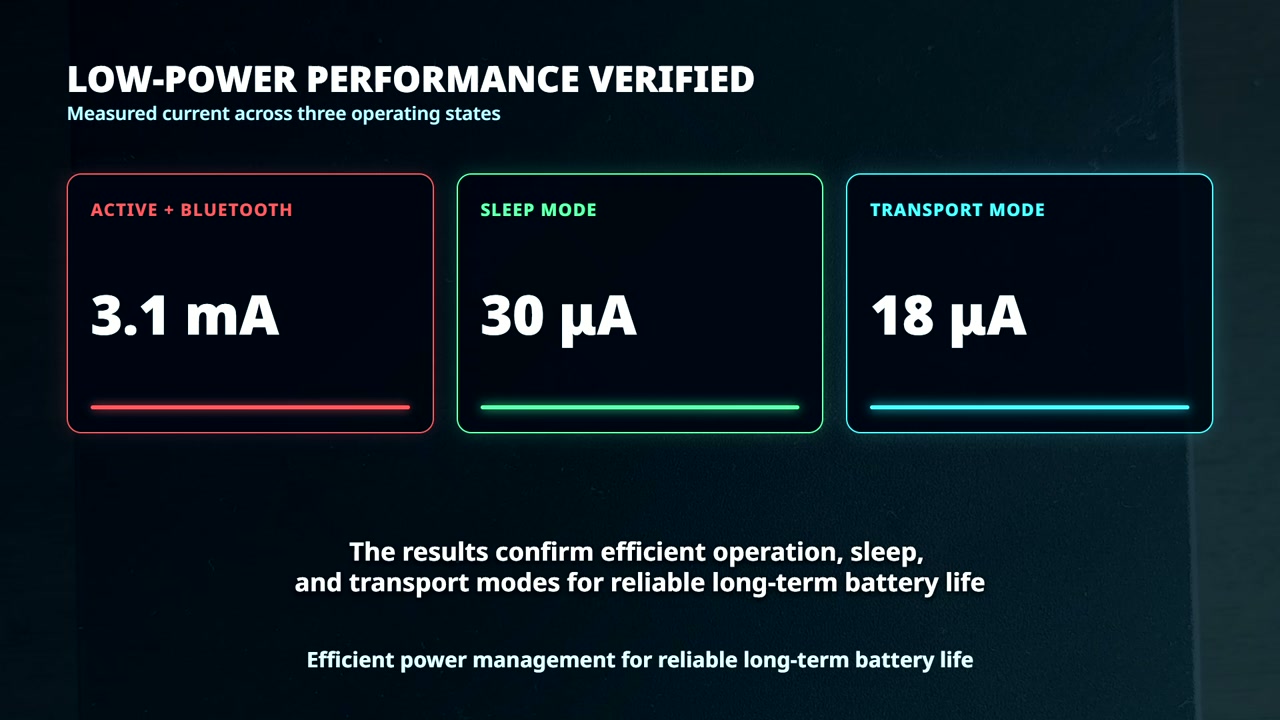
Circuit-board current can support a runtime estimate only when the measurement boundary, voltage, operating state and usable battery capacity all match the intended product. A chip current, a regulator-output current or one instantaneous sleep value normally cannot be converted directly into whole-device runtime. A final performance statement still requires the complete device and real battery.
When capacity divided by current is useful
A first-order estimate is T (h) ≈ Cusable (mAh) ÷ Iavg (mA). Cusable is the charge that the product can actually use under the relevant temperature, load and cutoff conditions; Iavg is whole-device average current measured at the battery boundary.
If the board measurement includes protection, charging management, sensors, display and all other real loads, it can approach the whole-device boundary. If it covers only a controller or one power rail, omitted loads must be added. Label capacity is not automatically usable capacity.
Do not mix current, power, charge and energy
mA is current, mW is power, mAh is charge capacity and mWh is energy. Dividing mAh by mA yields hours; when whole-device average power is measured, use corresponding usable energy divided by power. Do not divide mAh directly by mW.
Current on a 1.8 V or 3.3 V rail is not automatically the same as battery-side current. Conversion efficiency, voltage ratio and power-management consumption affect input current. Measuring the complete battery input is usually the clearest boundary.
Calculate each usage state separately
A smart boxing device may spend time training, connected but idle, advertising, sleeping and reconnecting. Multiply each state's average current by its duration and add the results. Do not add Bluetooth pulses again if they are already included in a measured average.
Example only: with 80 mAh usable capacity, one hour of training at 8 mA and 23 hours of sleep at 0.020 mA consume 8.00 + 0.46 = 8.46 mAh per day, giving about 9.5 days by simple division. Continuous operation at 8 mA gives 10 hours. These results describe different usage patterns and are not product specifications.
Why remaining capacity may not sustain training
The battery must supply short peak current while keeping voltage above the device's operating limit. Radio or processing pulses can cause voltage droop, leading to reset, disconnection or sensing errors even when some charge remains. Aging also changes usable capacity and load capability.
Turn the estimate into a defensible result
Build a time-weighted budget from complete battery-side measurements, then run the final battery with the specified app, sensing rate, wireless environment and training task. Record voltage, current, valid training time and the first moment the device cannot sustain the required function.
Separate calculated values, sample measurements and product targets. State sample count and revisions. For paired gloves, test both sides and use the shorter runtime as the usable runtime of the pair under the same task.
Frequently asked questions
- Will twice the battery capacity always double runtime? Only if usable capacity nearly doubles while average load and cutoff conditions remain comparable; verify the complete product again.
- Should Bluetooth power be added after measuring whole-device average current? No, not when the measurement already includes real Bluetooth activity.
References
Need a traceable validation plan for your project?
Tell us the target configuration, firmware and acceptance criteria. We can align test records with your OEM or ODM project.
Discuss a validation project