Short answer
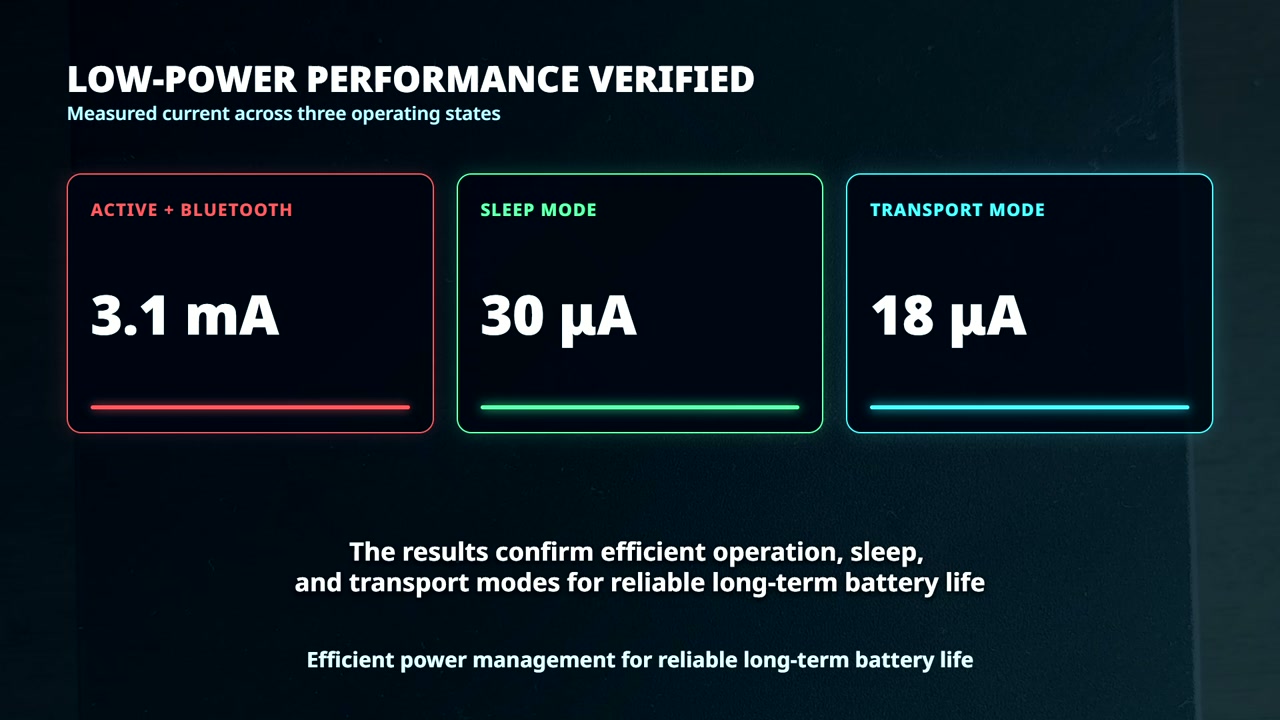
Bluetooth consumes energy while sending, receiving and scheduling training data. Runtime depends on how much data is transferred, how often and how long the radio is active, link quality and all other device loads. One transmit-current peak cannot tell buyers how long the product will train.
800 Hz sampling is not 800 Bluetooth connections
In a glove that samples an IMU and flexible pressure sensor at 800 Hz, the device acquires 800 groups per second, about 1.25 ms apart. Local sampling and wireless packet timing are different: samples can be buffered and bundled, and one connection event can carry multiple packets.
For illustration only, seven two-byte values sampled 800 times per second equal 7 × 2 × 800 = 11,200 bytes/s before timestamps, identifiers, sequence numbers and protocol overhead. This is not the WM-BF frame definition. Sequence numbers and timestamps are needed to confirm what the phone actually received.
Settings that change average current
- Connection interval changes event frequency, scheduling overhead, latency and queue depth.
- Packet bundling can reduce repeated headers but increases the waiting time of the earliest sample.
- Transmit power changes radio energy and link margin; it must be tested with body blocking and real training distance.
- Retransmission and reconnection can add activity when interference or obstruction degrades the link.
Measure average current and peaks
Average current estimates energy used over time. Peak current shows whether the battery and power path can support short radio or processing loads. A small battery can retain capacity yet suffer enough voltage drop during a pulse to reset the device or interrupt communication.
Record current peaks and the minimum battery voltage together. If transmission triggers resets, pauses or disconnections, investigate the battery, power path and measurement wiring before attributing the problem only to radio signal strength.
Validate in the gym, not only on the bench
Boxing continuously changes arm position and body obstruction while tablets, equipment and other wireless devices share the space. Compare near-range single-device operation, normal training positions and multi-device sessions. Record average current, disconnections, recovery time and received sample count.
After any power-saving adjustment, repeat valid-hit counting, combination punches, app feedback latency and sensor-data completeness tests. Lower current alone does not prove a successful optimization.
Frequently asked questions
- Will reducing sample rate always extend useful runtime? It may lower some load, but can also weaken peak capture and punch recognition, so both power and function must be retested.
- If AI runs on the phone, does the glove use no energy for it? No. The glove still senses, processes and transmits the data required by the phone model.
References
Need a traceable validation plan for your project?
Tell us the target configuration, firmware and acceptance criteria. We can align test records with your OEM or ODM project.
Discuss a validation project