Short answer
A credible low-power test combines current recording with functional verification. Measure the complete device at the battery boundary under documented supply conditions, exercise sleep, wake-up, Bluetooth connection and representative training states, then verify standby and active runtime with the real battery. One momentary microamp reading is not enough.
1. Fix the sample and test conditions
Record model and serial number, hardware and firmware revision, battery identity and state, temperature and test voltage. For gloves, identify left or right and record sensor sampling, app version and phone or tablet model.
Define the measurement boundary. Prefer the battery-to-complete-device path and state whether protection, charging management, sensors, display and accessories are included. A programmable supply is useful for voltage analysis but cannot replace a real-battery runtime test.
2. Choose an instrument for microamps and pulses
The instrument must resolve low microamp current while capturing short milliamp peaks, with sufficient sampling, integration and logging. A handheld multimeter can assist with stable current but usually cannot describe brief radio events.
An 800 Hz sensor sampling rate does not mean that 800 current samples per second are sufficient. Shunt resistance, leads and autoranging can change the voltage delivered to the sample, so check for clipping, range overload, reset or disconnection caused by the measurement system.
3. Remove alternate power and debug paths
Disconnect chargers, programmers and debuggers during normal battery-powered measurement. Check serial and GPIO wiring for alternate supply paths that bypass the current probe or add leakage. Keep all peripherals and firmware functions required in real training.
4. Record current and behavior by state
- Awake and waiting for connection: advertising average current and duration.
- Ordinary sleep: entry time, average current and whether advertising stops.
- Connected but idle: business state and connected-idle average current.
- Wake-up, disconnection and reconnection: success rate, recovery time and data freshness.
- Representative training: average, peak and minimum voltage plus valid-hit data completeness.
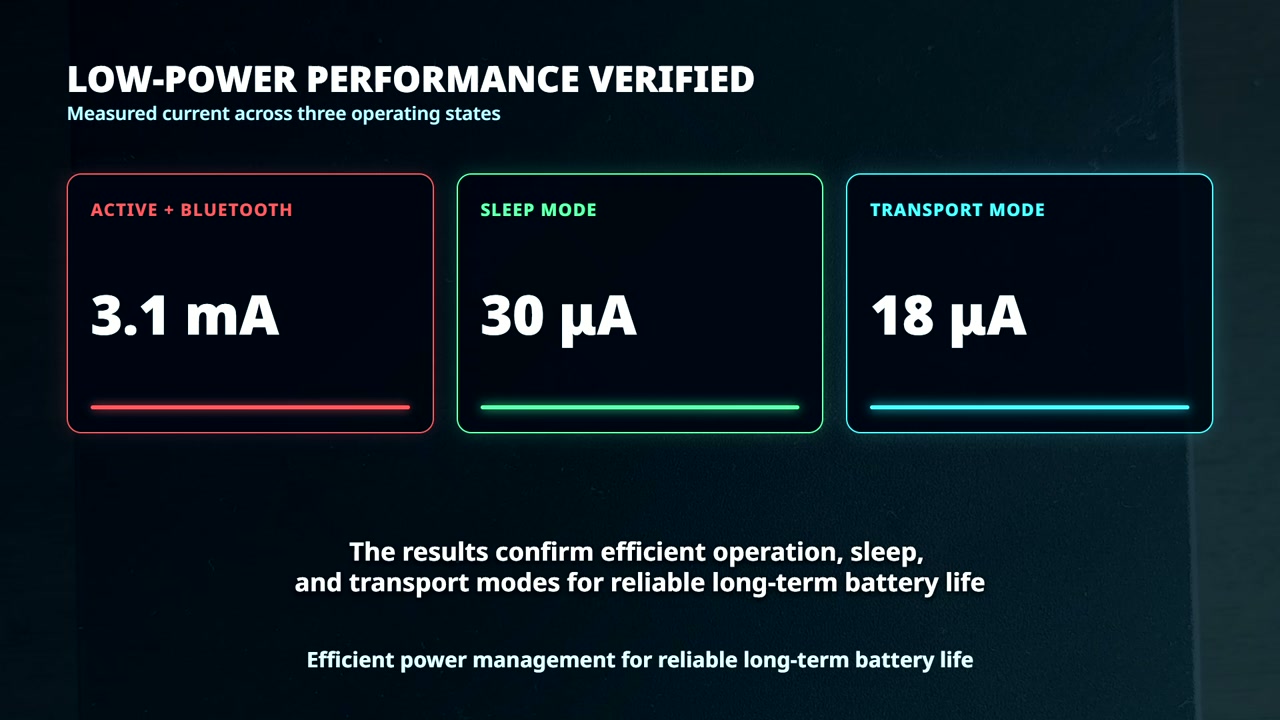
- Transport mode, where supported: current, accidental wake-up and reliable reactivation.
5. Validate long-duration behavior with the real battery
For standby validation, separate a periodically checked group from a continuously stored group so the inspection itself does not change the result. At the end, first wake, connect and perform the required function using the remaining battery before attaching a charger.
Continuous-training tests should keep the specified sensing, Bluetooth streaming, app features and representative hit load active. Define the endpoint as the first time the device can no longer sustain the required training function, not simply when an indicator turns off. Targets such as more than 30 days standby or more than five hours training remain validation targets until the specified configuration passes.
Build a reproducible report
Report sample and version, test conditions, sleep-entry time, average and peak current, minimum measured supply voltage, accumulated charge, connection and wake behavior, and key traces. Separate the measured minimum voltage from the product's specified minimum operating voltage.
Repeat engineering screening on multiple same-version samples to reveal variation. Production sample size, tolerance and acceptance rules belong in the project quality plan. A single boundary reading cannot qualify a batch.
References
Need a traceable validation plan for your project?
Tell us the target configuration, firmware and acceptance criteria. We can align test records with your OEM or ODM project.
Discuss a validation project