Short answer
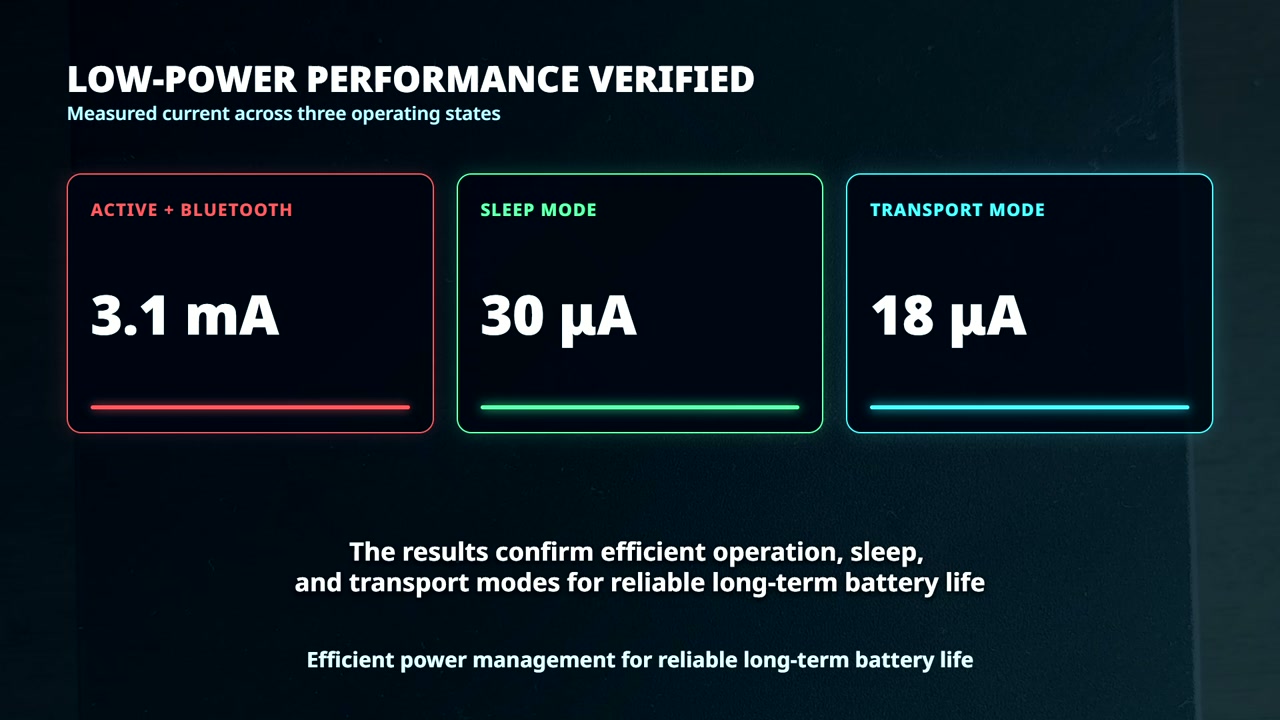
There is no single sleep-current value that applies to every smart boxing Bluetooth sensor. For the WM-BF, WM-BB, WM-BS and WM-HM configurations discussed in this guide, about 20 µA is a design reference for ordinary sleep and below 20 µA is a strict project target. The number must be read together with the hardware version, firmware, supply boundary and state-entry conditions; it must not be copied to another product without validation.
What the measurement includes
Sleep current is the current still drawn from the battery after the device enters a defined low-power state. A whole-device measurement can include the microcontroller, wake-motion detection, power management, battery protection and other loads that remain active. A dark display or extinguished LED does not prove that sensing, advertising or phone communication has stopped.
A chip data sheet normally specifies the chip under particular voltage, clock and peripheral conditions. Regulator quiescent current, sensing paths, protection circuits and board leakage remain outside that headline number, so the lowest chip value is not a finished-product specification.
Confirm the real operating state
In the device logic described here, an unconnected unit stops advertising and enters ordinary sleep after one minute without a hit or other activity. A unit with an established Bluetooth connection remains in its business state; one minute without a punch does not place the whole device into the same sleep state. After disconnection, a further uninterrupted minute of inactivity is required.
A sleeping unit may be designed to wake when moved or connected to a charger. During verification, use a new scan and current trace to confirm wake-up; a cached device name on the phone is not proof that the sensor is currently advertising.
What 20 microamps means
Twenty microamps equals 0.020 mA and is one thousand times smaller than 20 mA. If a load stayed at exactly 0.020 mA for 30 days, its calculated consumption would be 0.020 mA × 24 h × 30 = 14.4 mAh.
That calculation does not prove a 30-day standby claim. Battery self-discharge, unexpected wake-ups, omitted loads and the product's low-voltage cutoff can change the result. Sleep current, training average current and short radio peaks describe different states and must not be interchanged.
How to judge whether the number is credible
A useful record states the model, hardware and firmware revision, voltage, temperature, measurement point, observation time and the status of Bluetooth, sensors and wake sources. It records a stable trace long enough to include periodic activity instead of selecting the lowest point on the graph.
For a strict limit such as below 20 µA, the acceptance rule must include instrument uncertainty. Buyers should ask separately for ordinary sleep, connected-idle and representative training current; those three values are more useful than an unexplained claim of ultra-low power.
Frequently asked questions
- Does a dark display prove the sensor is asleep? No. Check the device state and current trace because Bluetooth or sensing may still be active.
- Should every smart boxing product reach 20 µA? No. It is a reference for the configurations discussed here; every product requires its own functional and electrical criteria.
References
Need a traceable validation plan for your project?
Tell us the target configuration, firmware and acceptance criteria. We can align test records with your OEM or ODM project.
Discuss a validation project